
Responsible Use of Artificial Intelligence in a Surveying Practice
Today’s announcement from the Royal Institution of Chartered Surveyors (RICS) introducing a landmark global standard on the responsible use of AI in surveying represents an important moment for our profession. From March 2026, all RICS-regulated firms must demonstrate clear governance, accountability and transparency when using artificial intelligence (AI) in professional practice.
At Ivy Lees, we see this not just as a regulatory change, but as an opportunity to strengthen client confidence while continuing to modernise how we deliver our services.
What the New RICS AI Standard Means for Us
The new RICS standard requires firms like ours to:
Maintain full professional accountability for all AI-assisted outputs
Implement clear governance and risk management procedures
Be transparent with clients where AI tools are used
Protect data security, ethics and professional judgment
In simple terms, AI can support our work, but it will never replace our responsibility as Chartered Surveyors.
How We Are Responding at Ivy Lees
We recognise that AI tools can assist with:
Analysing large volumes of building data
Identifying trends in defects or maintenance risks
Supporting report preparation
Reviewing technical lease documentation
However, every report we issue and every piece of advice we provide remains subject to our professional review and judgment. By combining AI with hands-on inspection and strong commercial awareness, we ensure innovation enhances our work without compromising professional accountability.
The new RICS standard places clear emphasis on governance, transparency, and maintaining professional judgment when using AI. For us at Ivy Lees, this means implementing complete oversight of any AI systems we use, including clear internal policies on when and how AI is applied, conducting risk assessments, maintaining audit trails for AI-assisted work, and ensuring full compliance with data protection legislation. This framework not only helps us manage risk but also strengthens our credibility with commercial landlords, tenants, and developers.
Of course, transparency remains fundamental to how we operate. We make sure clients are aware when AI tools are used to support analysis or reporting and explain how technology enhances the services we offer, without removing professional oversight.
Our value lies in the experience we have, particularly in complex commercial property matters such as dilapidations, condition surveys, and project advice, ensuring that technology supports our professional decision-making.
Applying the Standard in Our Day-to-Day Work
Issues encountered and areas explored utilising the benefits of AI include;
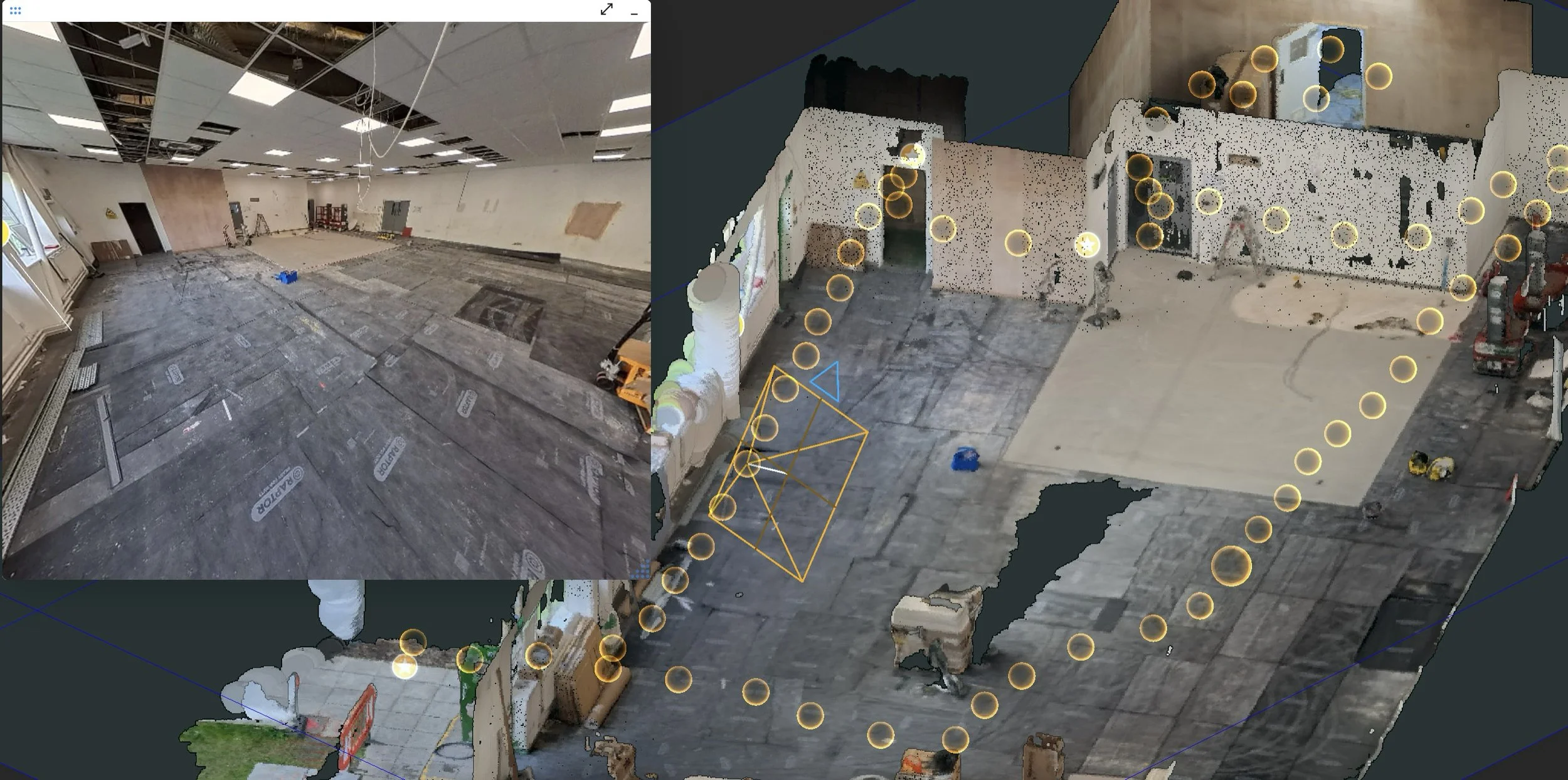
3D point clouds and models: Reality capture in minutes allows AI to process into point clouds, virtual tours and collaborative spaces. Traditionally, manual processing of high levels of data required significant input/output.
Defect reporting: Reality capture allows us to highlight any defects, report to stakeholders all in a fraction of the time.
Floor plans: Data can be converted into accurate, up-to-date floor plans, reducing the need for repeat site visits.
Progress monitoring: Reality capture allows us to create tasks, raise safety issues directly on the phone using drawings.
Compare: By creating digital copies of site inspections, we can easily revisit historic site progress photos. This also allows remote stakeholders to feel closer to the project even if they have never visited the site.
Choosing the Right Course of Action
Each survey, inspection and project is different, and requires different levels of accuracy in terms of measurements, or quality of images. The above approaches have been taken where project applicable. Before recommending any solutions, we take time to understand the broader context, including;
Accuracy - How accurate do measurements need to be? Where certain accuracy levels are required, we would likely suggest an alternative approach to the one above.
Budgetary and timing constraints – certain projects do not have the luxury of exploring these options.
Duration – If a project is due to last many months, the benefits of the above approach are likely. Where a project is much shorter-term, the time spent sourcing the data etc may not be feasible
Context – Factors such as site conditions play a key role in determining the most suitable approach.
Client appetite – Every client’s requirement is different. Some clients will see the benefit to taking the time to provide such models. Others may not see the benefit.
Once we have this information, we can get to work on providing a solution which is fully aligned with the RICS Responsible Use of AI standard.
Looking Ahead
The RICS Responsible Use of AI standard ensures that technological advancement enhances our work without undermining professional ethics, accountability or client trust.
By integrating AI responsibly into our processes, we continue to provide reliable, transparent and professional guidance, helping clients make the best decision for their project.
Please get in touch with any queries or to discuss your situation and we would gladly assist.
Insight provided by Lewis Livesey.